How it works
Suntell is a supply-side, or positive-pressure, whole-home ventilation system. This page explains the general science from public sources and then shows how the Suntell unit applies it.
Airflow through a home with Suntell
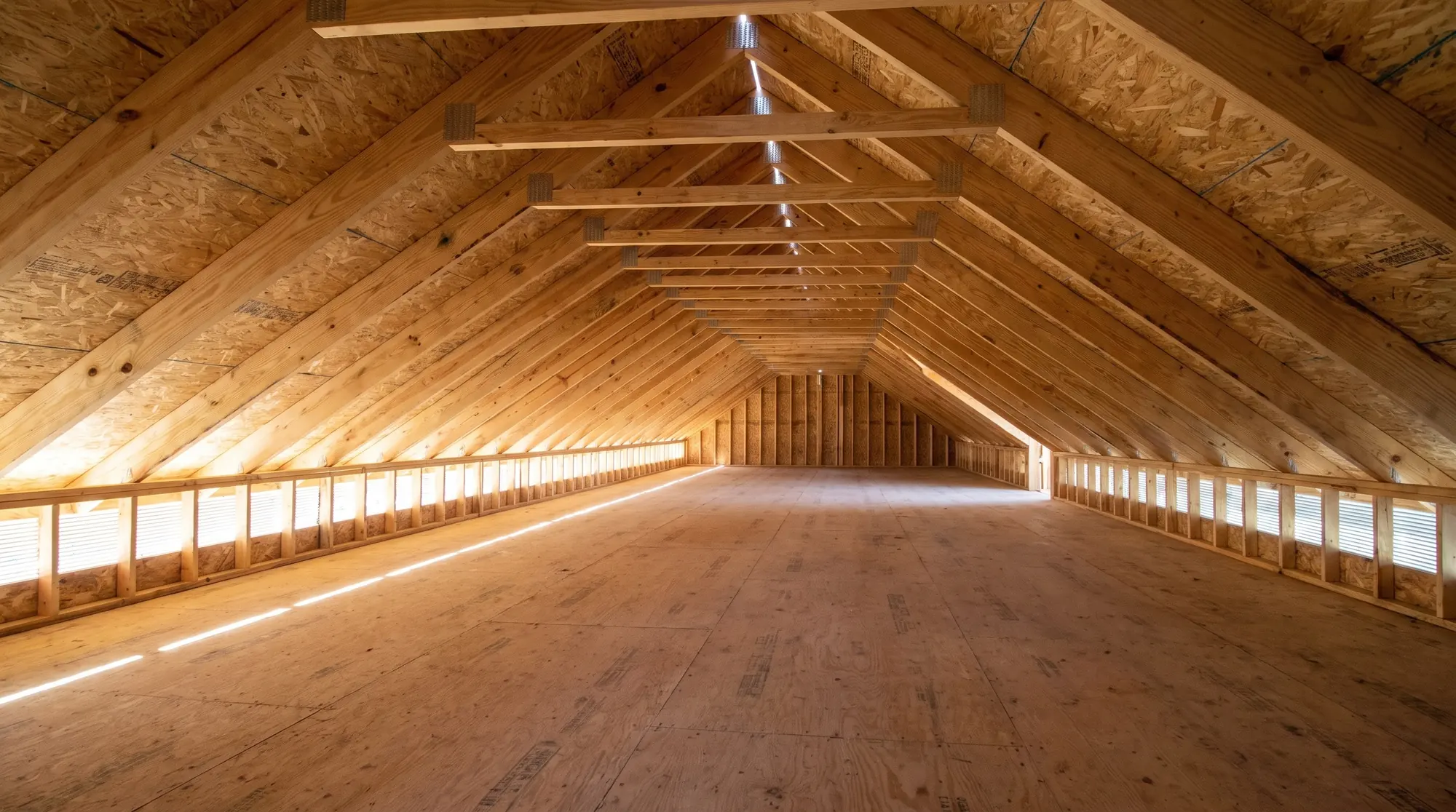
Unit mounts in the attic
Near the existing soffit vents. No structural modifications, no roof cut, no duct runs.
Plugs into a standard 120 V outlet
The unit draws 27 W and the manufacturer says no special electrical work is needed. Where the attic has no outlet, adding one is a licensed electrician's job under local code (our guidance, not a manufacturer requirement).
Outdoor air enters through the soffit vents
The unit pulls air from under the eaves and passes it through its built-in MERV-8 filter.
Filtered air pushes into the living space
The home sits at a slight positive pressure, so stale air leaves through existing gaps and exhaust ducts instead of being drawn in unfiltered. The connection from the unit into the living space is drawn schematically; the manufacturer's documentation does not detail it.
Original schematic drawn for this site, not to scale. Steps 1 to 4 follow the manufacturer's operating description; the licensed-electrician note is general code guidance from us.
Three ways to ventilate a house
Building codes require whole-house mechanical ventilation in new homes. The U.S. Department of Energy groups the options into three families.
- Exhaust. A fan pulls air out of the house and depressurizes it; replacement air is drawn in through leaks in the shell, wherever they happen to be.
- Supply (positive pressure). A fan pushes outdoor air in and pressurizes the house; stale air leaves through the shell, bath and range ducts and intentional vents. This is Suntell's approach.
- Balanced. Separate supply and exhaust fans move equal amounts of air, often through a heat- or energy-recovery core (HRV or ERV), with dedicated ductwork.
Why pressurize
According to the Department of Energy's whole-house ventilation fact sheet, supply systems work by pressurizing the building: a fan forces outside air in while air leaks out through holes in the shell, bath and range fan ducts and any intentional vents. Pressurizing the house discourages the entry of pollutants from outside the living space and helps avoid backdrafting of combustion gases from fireplaces and appliances. Because the incoming air comes in at one point, it can be filtered to remove pollen and dust.
The same source says supply ventilation is most applicable in hot or mixed climates. In cold regions, pushing moist indoor air outward can let it condense in the attic or in the cold outer parts of exterior walls, where it can promote mold, mildew and decay. Supply and exhaust systems can also cost more to heat and cool than heat-recovery systems because the incoming air is not tempered first.
What Suntell adds to a supply system
Most supply ventilation in the U.S. is built around the central air handler: an outdoor-air duct tied to the return side of the furnace or air handler, with the blower running on a timer. That works, but it depends on the HVAC system, needs ductwork and commissioning, and runs the big blower to move a small amount of air.
Suntell is a standalone supply unit. Per the manufacturer's documentation:
- It mounts in the attic near the home's existing soffit vents, so the intake needs no roof penetration.
- It has its own EC motor (27 W, 95 CFM, speed adjustable) and no ductwork.
- Incoming air passes through a built-in MERV-8 filter before it reaches the living space.
- It plugs into a standard 120 V outlet.
- Noise level is 33 dB, and the unit is in the attic rather than in a closet or living area.
How it compares, per the manufacturer
| Criteria | Suntell (supply) | Exhaust fans | ERV / HRV |
|---|---|---|---|
| Roof penetration | None (soffit intake) | Usually 1 | Usually 2 |
| Ductwork | None | None | Extensive |
| Air quality | Excellent (filtered) | Poor (unfiltered) | Excellent |
| Specialist needed | No (electrician) | No | Yes (HVAC tech) |
| Installation time | 1 to 2 hours | 1 to 2 hours | 6 to 8 hours |
Rows and wording are the manufacturer's comparison table. "No (electrician)" is the manufacturer's entry; our reading is that an electrician is needed only where an outlet has to be added.
What MERV-8 means
MERV, Minimum Efficiency Reporting Value, is the ASHRAE 52.2 scale that rates how well an air filter captures particles of different sizes; higher numbers capture smaller particles. Suntell's built-in filter is rated MERV-8. The manufacturer has not yet published a filter replacement interval or part number; both will be added here when they are on file.
Where it fits, and where to be careful
Pepnice names hot and mixed climates (Texas, Florida, California, Arizona), the humid Southeast and the West as its primary markets. Supply ventilation is most applicable in hot or mixed climates; in cold climates it can push moist indoor air into cold wall and attic surfaces, so get local HVAC advice before specifying it there.
Check the rate for your home
Compare the IRC whole-house rate for your floor area and bedroom count with the PIV 100NA's 95 CFM.
References
- U.S. Department of Energy, Building Technologies Program, "Whole-House Ventilation Systems: Improved Control of Air Quality" (fact sheet), web.ornl.gov/sci/buildings/docs/factSheets/.
- Building America Solution Center (Pacific Northwest National Laboratory, U.S. DOE), "Whole-House Ventilation Strategies for New Homes", basc.pnnl.gov.
- Shenzhen Pepnice Technology Co., Ltd., "Suntell Whole-Home Ventilation System" product documentation, technical specification for model PIV 100NA (2026).
- ASHRAE Standard 52.2, Method of Testing General Ventilation Air-Cleaning Devices for Removal Efficiency by Particle Size (MERV rating scale).